Šilainiai Artist In Residence, Šilainiai microdistrict, Kaunas, Lithuania
Artist mini-residency program set up by Lithuanian artist Evelina Šimkutė.
International artists stay with a host family in Šilainiai for one to two weeks and make works in public spaces. There are opportunities to work with local schools/ community groups and exhibit works in local venues. More information on project website: www.silainiaiproject.com and Facebook page.
 Artist Marija Nemčenko working in Šilainiai, 2016
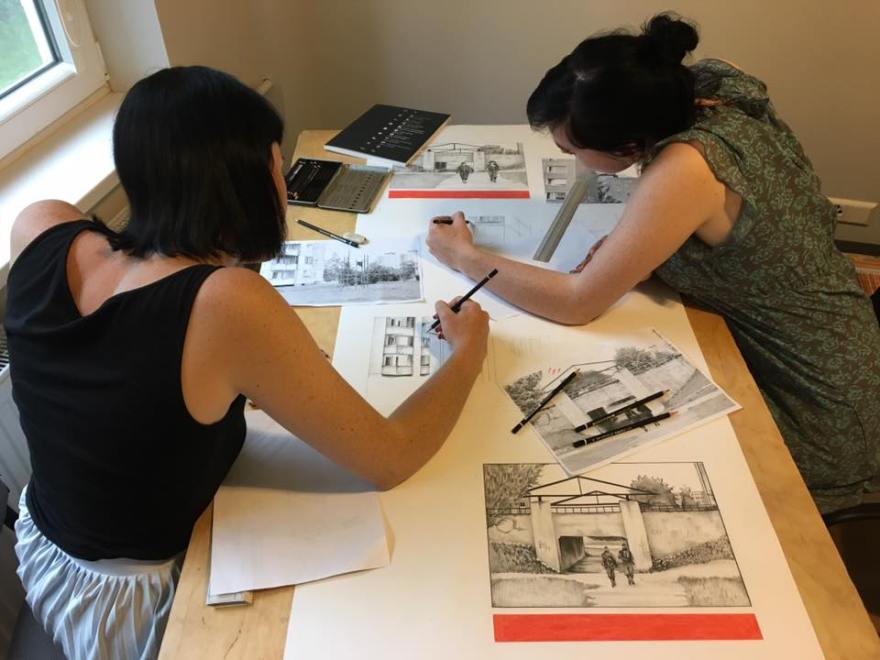
Artists The Lake Twins working in Šilainiai, 2016
Project curated by artist Evelina Šimkutė is one of the first who stepped into Šilainiai micro-district of block multistory houses, culturally separated from the city centre. The artists were staying in this micro-district by means of ‘couch-surfing’ in summer of 2016, where they developed new artworks. Also they made connections with local community, presenting their creative work publicly and participating in open meetings in a public library of Šilainiai.
Šilainiai Project is an initiative oriented to the local community of various generations and in this way is part of other Lithuanian and foreign practices seen in micro-districts – open creative social platforms, community and participatory arts and others. International artist residency is one of the many activities led by Evelina Šimkutė in Šilainiai, which help and start to reveal the cultural identity of the last developed micro-district in Kaunas in Soviet times. The project conducts an artistic, also historical and social research of Šilainiai, communicating with the people who created it and examining the collected archival material.
V. Stepanovaitė
Šilainiai Project: exhibition of international art residency
31th of October – 14th of November, 2016
Project space Kabinetas (A. Mapu g. 20, Kaunas, Lithuania)

Evelina Šimkutė (UK / LT)
Object 5
Concrete, wood
2016
Evelina Šimkutė’s work could be considered to be a notably material investigation of a changeable neighbourhood of Šilainiai as a wider cultural, social and urban area. It evokes active memory through making copies of concrete objects from the abandoned soviet playgrounds – as a monument for the utopian idealistic past and the future which is unknown. The copy of an object is fresh, polished, enabling the run-down objects to come back to their primary physical state; it gains the meaning when it is being moved to the closed and sterile surrounding. New relations between the material and the context are being discovered: the sculpture embodies and at the same time denies the decay, it marks a constant change of reality, memories and space.
The works of Evelina Šimkutė operate in the field of visual art and curatorship, they are based on the investigations of time and space. In 2012 she finished her studies in the Central Saint Martins Arts college. The author also implements decentralization practise based socio-cultural projects in the Šilainiai neighbourhood of Kaunas – “Šilainiai Photo“ and “Šilainiai Project“.
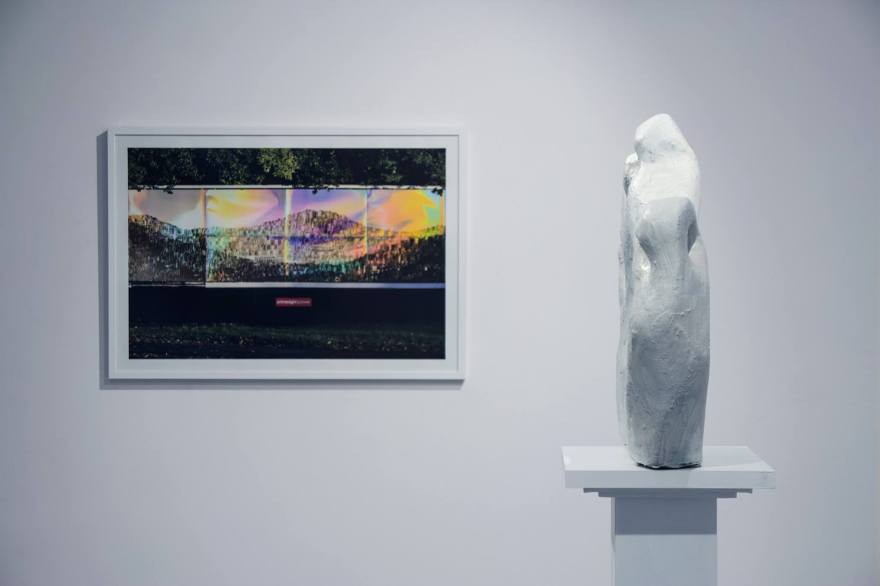
Marija Nemčenko (Lithuania / Scotland)
For each individual gold glitters in a different way (All that glitters is not gold)
Original artwork:
Screen printing, holographic plastic
3 m x 1,5 m
In the picture – mock up of a proposed artwork in the public space:
Digital print on a billboard
2016
Do you know that feeling when during a journey your eyes follow an outline of a horizon extending to the distance? When colours in the sky mix and merge together as if they were painted with watercolour ‒ red with yellow, blue with purple? When it seems as if time stops and immerses you in a particular parallel state – while at the same time your mind wanders in the past, present and future? How looking at that landscape which extends to infinity, a man feels mesmerised by the tangled lines? I am often faced with this feeling while travelling. Submerged in this escapist dream, I often had to remind myself that what I am seeing is a variegated hyper-realistic mirage, a reality which is influenced by the distance and otherness, something which is not casual and is, to some extent, exotic.
Experiencing this feeling for the first time when I came back to Kaunas, I realised that both the physical and metaphorical distance changed my attitude to what was familiar and banal in the past. The so-called colony of the blocks of flats in the neighbourhood of Šilainiai became exactly that romantic landscape extending to the distance. Its monumental forms attracted the tourist’s eye and lured me too. It is no wonder that these industrial large-planch blocks of flats especially attract the tourists, however, at the same time this attraction is dangerous for Lithuania’s future vision, immersing the country in the Soviet past. My work attempts to examine the dual meaning and importance of these monuments of totalitarian architecture in Lithuania and abroad.
Created using the method of serigraphy print, by the method as well as its representation this work offers the spectator to interpret it with regard to advertisement and tourism industries. “For each individual gold glitters in a different way“ work acts as an advertisement which tempts to visit this fictional and at the same time realistic space.
Marija Nemčenko graduated from Glasgow School of Art (Glasgow), holds a Master of Fine Arts. She participated in personal and group exhibitions, residencies in Lithuania, Scotland, the United Kingdom, the Philippines, Morocco and Portugal.

Milda Gailiūtė (Šilainiai)
Untitled (Šilainiai)
Oil on canvas
21 x 28 cm
2016
It is possible to say that Šilainiai is my homeland. I was growing up here since I was six.
I remember that I truly used to say that Šilainiai needs more greenery. But right now, because of the trees, it seems that concrete is shrinking – it decreases.
Of course, the change of the viewing angle – as it happened this summer while looking to Šilainiai from the rooftop, gives the opportunity to see generalized view without particular details. The greenery of Šilainiai was seen from above.
Milda Gailiūtė is a young Lithuanian painter who lives and works in Šilainiai. Sense of place is an important part of her work. She captures details with photography and then makes paintings based on them in the studio. Milda chooses to work with one colour, which is different for each location. “It is important for me to create work in the place where I live, about that place. Sometimes I return to locations in my memories and paint them in my studio.” – says the artist.
My projects usually associate with spaces. The largest series of my paintings relate to Žagarė (2008 – 2012) and Vienna (the capital of Austria, 2012 – 2014), where I temporarily lived. I created in these residencies for a short period of time, later I continued my projects in a studio in Kaunas. However, for quite some time I paint the places that are important to me personally. Šilainiai is one of them.
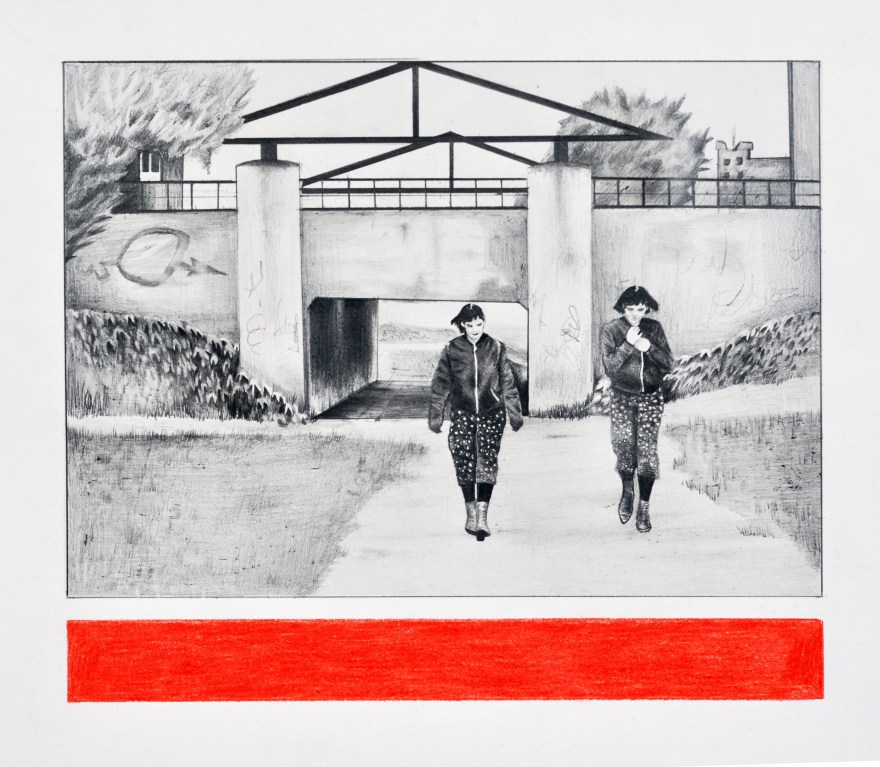
The Lake Twins (UK)
Silainiai Photo Walk
Pencil on paper
145 x 63 cm
2016
Our experience of Šilainiai is explored and documented through drawing. The composition of the drawings is based on a photo walk during our initial days of exploration. We used drawing both as a means of studying the district in which we spent eleven days and to discover how similar our perceptions of Silainiai were, to observe how closely we perceived the site as twins. Equally, we found that through detailed drawings we could capture a growing personal connection with Silainiai during our time there.
The Lake Twins are London based artists who exhibit internationally. They were born in Greenwich in 1990 and began collaborating during their BA Hons at Central Saint Martins College of Arts and Design (2008-2012). Their practice is predominantly site specific and multi-disciplinary, consisting of drawing, painting, film, installation and text based work, all of which focus on their identity as identical mirror twins and connections with the site in which they make work. Their work has been exhibited and archived in galleries, heritage sites, educational institutions and private collections globally. Such institutions that archive The Lake Twins work include the Central Saint Martins archive that holds The Lake Twins degree show in its entirety, and the Floodlight Foundation in Delhi, India, founded by Surbhi Modi. As students, The Lake Twins were involved in Damien Hirst’s twins installation at Tate Modern gallery and additional projects at Tate Britain gallery. More recently The Lake Twins have been invited to give talks at various London galleries and heritage sites where they have exhibited.
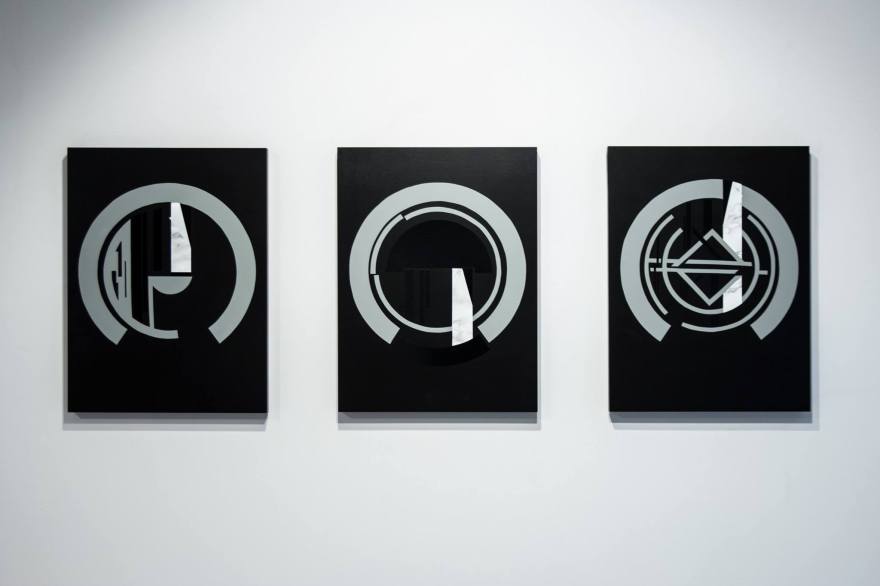
Francis Olvez-Wilshaw (UK)
Charlemagne VII-IX (out of VII-XII)
Collage – wood, vinyl, paint
60 x 45 cm
2016
In these six collages, Francis displaces logos and symbols from the world of high finance and reconstructs them into an array of different collages. The designs allude to the anonymity that they require but still ensure their presence in our world is denoted through their logos, financial visual language and high rise offices. The work aims to unpick that veneer and express the position that the highly complex models that have been the foundation of modern commerce over the last thirty years are starting to unravel.

In search of another Laocoon
Sculpture – mixed media
158 x 50 cm
2016
In this sculpture, Francis uses the hellenistic Greek sculpture ‘Laocoon and His Sons’ as his primary reference point. Although the original sculpture displays a suffering that is grandiose and heroic, Francis’ reinterpretation is stoic and quite violent. The expressive face of the priest has now fallen away, leaving a hole and the suggestion of a head that has been eroded.

Brooke Carlson (Australia)
Sovereignty is nothing (sand and stone)
Video with sound
12 min.
Performed on 28 July, 2016, public street, Baltų av. 81, Kaunas, Lithuania.
This is the first time I have visited Lithuania. This is also the first time I have worked in public spaces. During my visit to Ninth Fort in Kaunas, I witness the fragments which evidence the harsh conditions of war, the extremity of unbearable pain and cruelty. I begin to reflect on my own personal experiences of suffering which cannot be compared in the slightest. On this day, 23 July, 2016, I write the diary entry: “We think we know pain, but we know nothing. We think we know what it means to breathe, but we know nothing. We think we’ve seen thing, but we’ve seen nothing.”
This thirteen minute performance, “Sovereignty is nothing”(sand and stone) happened in the final moments of my residency, as if a rupture in response to everything I experienced during the five day period.
I subject my body to vulnerability by positioning myself on the ground of a public space.
My body appears out of the ordinary and my action soon becomes a disturbance.
I am seen as “unwell” or in “need of an ambulance.”
It is summer and almost thirty degrees.
Knelt to the ground, I grind a single sandstone into minuscule particles.
Repeat, repeat, repeat.
I silence myself in submission to the action.
The duration of the performance is determined by the point of exhaustion.
The labour in making the mark, only to exist temporarily, speaks of the ephemerality of our human existence.
“Sovereignty is NOTHING” – Georges Bataille (cited by Maurice Blanchot in The Writing of the Disaster, 1980).
Shota Kotake (Japan)
Moments from Šilainiai Project end of the year exhibition, 2017
For more information please visit www.silainiaiproject.com.
 Evelina Šimkutė